
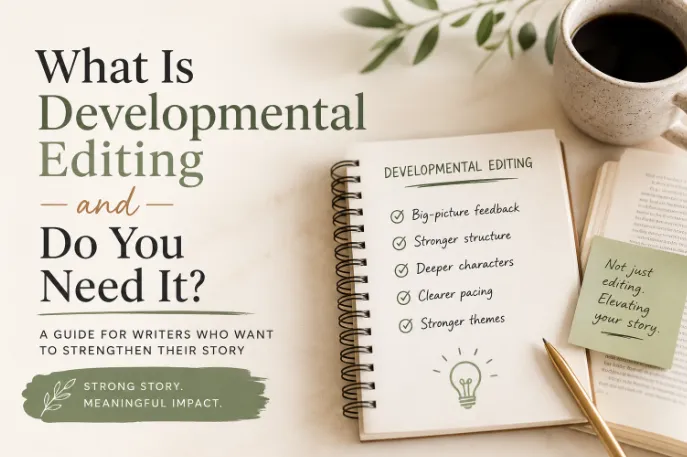
Developmental editing is the most misunderstood stage of the publishing process. Authors who have never worked with a professional editor often skip it entirely, believing their manuscript is structurally sound when it is not. Authors who have worked with one rarely skip it twice. Here is what it actually involves and how to know whether your manuscript needs it.
The Definition That Actually Helps
Developmental editing; also called structural editing or substantive editing — is editorial feedback focused on the overall architecture of a book. Not grammar. Not sentence-level prose. The big things.
Does the book have a clear central argument or narrative thread? Are the chapters in the right order? Does the pacing serve the story or fight it? Are there sections that drag, confuse, or repeat themselves unnecessarily? Is the opening strong enough to hold a reader who does not already trust the author?
A developmental editor reads your manuscript as a reader, then responds as an editor. They identify what is working, what is not, and why. They recommend specific changes, sometimes substantial ones, and explain the reasoning behind each recommendation.
The result is usually a detailed editorial letter running anywhere from five to twenty pages, sometimes accompanied by in-manuscript notes. It is not a copyedit. It is a diagnosis.
What a Developmental Edit Actually Looks At
Structure is the primary focus. In nonfiction, this means whether the argument is logically sequenced, whether each chapter advances the reader’s understanding, and whether the conclusion delivers on what the opening promised. In fiction, it means plot architecture, character arc, pacing, and whether the story’s internal logic holds.
Voice is the second concern. Not in the grammatical sense but in the authenticity sense. Does the narrator sound like a consistent and believable person throughout? Are there sections where the voice shifts in ways that feel unearned or inconsistent?
Reader experience is the third. A developmental editor reads with one question running constantly in the background: what does a reader who was not there, who does not already know this material, actually need at this moment in the book? That question catches assumptions authors make that readers cannot follow, context that has been omitted, and explanations that arrived too late.
The Manuscripts That Need It Most
Every manuscript benefits from developmental editing. Some need it urgently.
First drafts almost always need it. The act of writing a first draft is an act of discovery. Most authors do not fully understand what their book is about until they have finished writing it. That understanding needs to be built back into the structure before the manuscript is ready for the next stage.
Manuscripts that grew organically over a long period without a clear outline often have structural problems that the author cannot see because they are too familiar with the material. The chapter order that made sense as it was being written does not always make sense to a reader encountering the material fresh.
Books with multiple storylines, complex arguments, or non-linear timelines carry the highest structural risk and benefit most from the outside perspective a developmental editor provides.
Fiction editing services include developmental work specifically tailored to the demands of narrative fiction, where pacing, character consistency, and plot architecture require a different editorial lens than nonfiction.
When You Can Skip Developmental Editing
Realistically, there are situations where developmental editing is less critical. A short ebook with a simple, linear structure and a clear single purpose. A manuscript that went through extensive developmental feedback during the writing process, either through a writing group, a collaborator, or a ghostwriter who built the structure professionally.
Christian editing services for devotionals and shorter faith-based works sometimes fall into this category, where the structure is simpler and the primary editorial needs are at the copy and line editing level rather than structural.
But for any full-length book intended for a general readership, the honest answer is that skipping developmental editing is a risk most authors cannot afford.
The Cost of Skipping It
A manuscript that goes to copy editing and proofreading without a developmental pass may be grammatically clean and structurally broken. Readers notice. Reviews notice. The author notices, usually too late.
The alternative is finding the structural problems before the book is published, when they can still be fixed. That is what developmental editing is for.
Frequently Asked Questions
Can I do developmental editing myself? You can do a version of it. Reading your manuscript from the reader’s perspective, making an outline of what is actually on the page rather than what you intended to write, and asking hard questions about structure are all useful. But the distance required to see your own work clearly is genuinely difficult to achieve. Most authors benefit significantly from external perspective even if they are strong self-editors.
How long does developmental editing take? For a full-length manuscript, a thorough developmental edit typically takes two to four weeks depending on the editor’s availability and the complexity of the manuscript.
Does developmental editing mean rewriting the book? Not necessarily. Some manuscripts need significant restructuring. Others need targeted adjustments. The scope depends entirely on what the manuscript needs, and a good developmental editor distinguishes clearly between the two.
Is it the same as a manuscript critique? Similar but not identical. A manuscript critique typically provides high-level feedback on the book’s overall strengths and weaknesses. A developmental edit goes deeper, providing specific, actionable recommendations for every major structural issue identified.